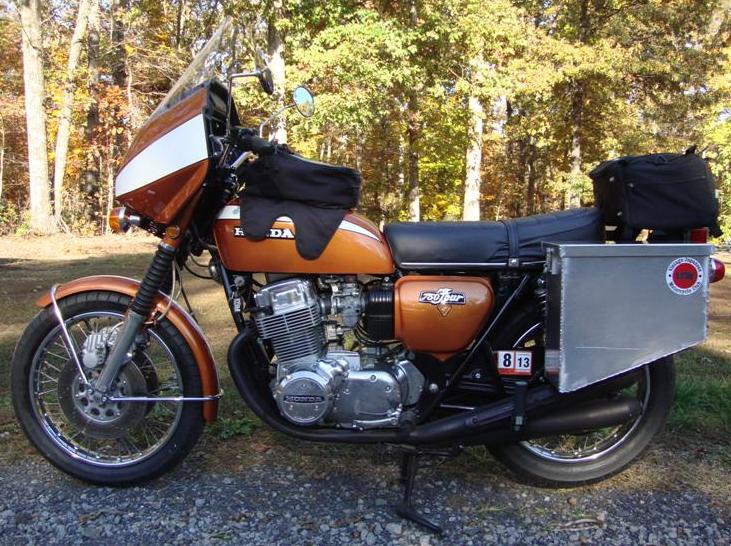
1974 Honda CB750 K4
Mechanical Service with some Cosmetics
Owner & Writer: Randy Creel, Jr., Owner & Restorer of Randy's Cycle Service & Restoration
COMMENTS: This page is an ongoing write-up of Randy's mechanical & cosmetic service to the bike he'll personally be riding during the spring/summer 2010.  Weekly to bi-monthly write ups, some technical some personal, will be posted along with pictures & a video of the progress.  Notifications of new postings will appear on Facebook & emailed to interested bike enthusiasts.  To siign up for email notices, email your interest to info@rcycle.com.
A couple weeks ago when just before turning in and perusing one of the
many motorcycle magazines I subscribe to, I ran across a story about an early
Honda CB750.  Having owned a ’73 CB750 K and put nearly 70,000 on it some
years back, I decided it was time to resurrect another one and head for the
road again. Why such a soft spot for the 750?  It was my first “real” street bike
as a new driver/rider (one that was large enough to ride the Interstates with)
and it was also one with which I became so very well acquainted over the
course of 31 days back in 1992 traveling roughly 7,500 miles around the country. So, with pad and pen in hand I began making a list of what I’d need to assemble the loose collection of parts I’ve accumulated over the past several years with just such a project in mind.
The bike is a 1974 Honda CB750K4 that I've had in storage now in pieces for over 10 years along with a number of spares, new parts, and piles of ideas floating around in my head. This could get interesting ...
Stay tuned for updates as this project rolls along. The plan is to take this Honda, do what is necessary to get it roadworthy, make it mechanically and cosmetically sound, but not go to full restoration level, do a few sensible modern upgrades, and report on some real-world experience with a now 36 year old machine both in the shop and on the road. I hope you'll follow along!
Next update: Compiling the necessary parts and assessing the job to get this Honda back in one piece.
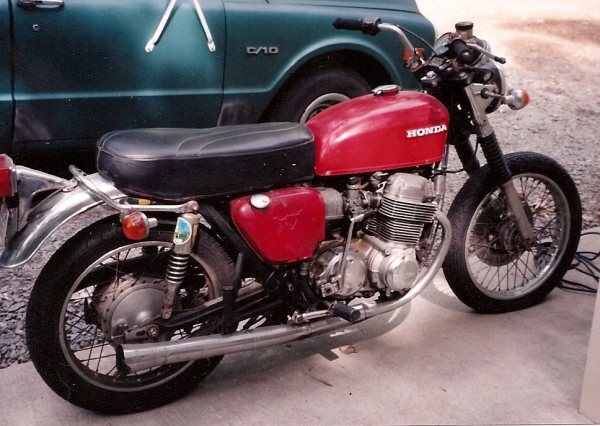
The bike in its BEFORE state.
These were taken in 1998 - 1999 when I first obtained the bike for about $200.
Posted April 20, 2010 - 1st entry
When talking in bike circles with fellow enthusiasts, I  I get asked with some frequency, “So, what do you ride?”  Quite frankly in the last 10 years I haven't been able to come up with a suitable answer. Not that I haven't owned a number of bikes in that time period, but most have been show pieces, small CC singles and two-strokes relegated to short hop riding around the local back roads, and getting the necessary mechanical attention before, during and after the ride.
My last large motorcycle of significant displacement was my original ’75 Honda GL1000 Gold Wing, which had sat for precisely 4 years in my showroom going nowhere, as home, business, and other projects took precedence.  I realized that it was best to pass it on to a good, loving owner who would enjoy it as much as I had in the 45,000 miles I put on it, variously touring across the continent once and up and down the East coast numerous times.
Since selling that GL a couple years ago and riding only the smaller bikes very occasionally, I've now decided to hop back into riding again and hopefully turn my love for riding vintage bikes back into a regular part of my leisure time. Plus, you haven’t lived until you’ve tried to ride a mid-60's Benelli 125cc two-stroke on a busy 55 MPH two-lane highway with a large 18-wheeler close behind & in a hurry.
Posted April 28, 2010 - 2nd entry
The Reality
    Oft times, vintage motorcycle folks spot a basket case bike and say one of several things: “That won’t take much to get going again.” or something like “Shouldn’t be too expensive to get back on the road.” or even “That doesn’t look that bad.” Such optimism…
    I mostly fall into the last category with a soft spot for the forlorn pile of rusty leftovers, abandoned in the corner of the swap meet pile awaiting a savior to reassemble it into something resembling and functioning like a motorcycle. The rarer, and more obscure, the better in my book as it makes the finished product even more unusual and attention getting.  Doesn’t everyone appreciate a 1962 Jawa Pionyr with the best Eastern Bloc engineering the point of a gun could enforce?  Plus, everyone else doesn’t own one that looks just like it.  That wasn’t the idea, of course, with this project as Honda CB750s are not exactly rare.  What did happen was that a formerly complete (although incorrect) bike was at one point in a rideable chunk, then became that same forlorn pile forgotten for a long time in the corner. I always ask when I acquire just such a basket case, “How did XYZ machine get in such a condition?”  I think I have my answer.
    Here’s how it happened to this one: About 1999 or so, this ’74 CB750 became mine through a couple trades and I decided to restore it to replace my just sold ’73 CB750, which is now somewhere in Finland to the best of my knowledge. I pulled it down, began the same process I’d done a few times before of cataloging, organizing, and degreasing the basic elements of a motorcycle, then became involved in marriage, constructing a home, starting a new job, starting a business, and a half-dozen other important things. The 750 first got moved to the side of the shop, then the corner of the shop, then under the bench, then to the storage shed, then to a separate storage building, and finally spread around approximately 3 different buildings as the business expanded and other things took priority.  It was largely forgotten, save for the frame which looked me in the eye every single time I had to retrieve a part from our storage building.  It unblinkingly reminding me that I had committed myself to bring this Honda back to the road. Finally, as I explained before, the time had come and I needed to get back on the road, so I started the assessment.
   Literally, it took me about 6 hours to make a list and sort all of the bits,
then pile them all into one neater and semi-organized pile that would become
this bike again. Some of the parts were as I remembered them and some not
at all and more still were non-existent in this dimension. (Or squirreled away in
that spot I forgot to look in.)  Funny how you remember things so much
differently after 11 years have passed. Anyway, about 95% of the bike is here
on-hand now, and in a state where the work can begin. I decided very quickly
on that I don’t want this to turn into such a full-blown restoration that at the
first sign of a raindrop, I’ll be headed for the garage to wipe, polish and buff
away any sign of use.  No, it will be a rider for sure and a decent looking one at that. It won’t be original to the 100 point concours level either. Practical, simple, enjoyable, and realistic are all terms that keep popping into my head as I form my ideas and proceed with this project. As it stands now, the frame has been stripped to the bare metal (how we prefer to start all our restorations) and painted.  Now it's on the bench ready for a build-up. One part of the plan is to build the key components such as the frame, electrics, and engine back to the point so that in the future, this bike can be put to perfectly original as time, money and preference dictate. The bodywork colors may be a shade off from correct, the fenders will probably get painted for now as the chrome is not perfect, and the wheels are clean originals, not re-laced or re-chromed units. All of these are things that can be gone back and done later with a minimum of fuss and not nearly as much time as a total rebuild. Ride a couple weeks, then spend a Sunday getting the new wheels done up, sort of thing. An ongoing project, that will change, or maybe not depending on how it performs.
    Next update: Frame build-up, electrical, upgrades, and missing parts acquisition
Pictures from 1998-99 when I first obtained the bike.  This was when it was still in shop and before it made it's journey to the land of "I'll get to it when I can" projects.
April 2010: the frame painted & drying in the paint book
Posted May 5, 2010 - 3rd entry
Now that the frame is painted and situated on the bench, build-up can begin.
    The suspension was as I expected after 35 years of neglect, but overall, not unserviceable. The front forks have come down completely to polish the lower legs, and in the process all new seals, springs and oil were installed. The chrome on the fork sliders was perfect and prevented having to replace the tubes. The rear shocks were leaking, but a fresh set of Progressive rears took care of that issue and modernized the rear suspension as well. Coupled with the Dunlop tires I’ve chosen, the bike should handle fairly well, or as well as a Honda CB750 does with the benefit of 35 years of progress in design.
    Electrically speaking, the wire harness was also in decent shape, but the CB750’s do have a few problem areas that I addressed prior to installing the entire harness.  This way, I won’t be left along the side of the road some dark and wet evening to sit & question why I didn’t do the necessary repairs when I had the chance - now.
    One issue was the fuse box that came standard on the original K models. They used 4 of the old AGC glass tube fuses. While they were fine for 1974, add a few years of use, vibration, loose or dirty connections, and lack of maintenance to any of the other electrical areas, and you have a failure waiting to happen. Generally, the fuses start to lose connection where they clip into the fuse box tabs where corrosion starts. This creates a high resistance connection and in turn creates a lot of heat. With a plastic base that the fuse connectors reside in, soon, they melt the fuse box and lose connection completely. Not so bad if its just the taillight fuse, but usually it’s the headlight or worse yet, the main fuse.  To rectify this weakness, I installed a small, four position ATC blade-style fuse box. This makes several good improvements: First, the ATC fuses are much less susceptible to vibration.  Second, they are easier these days to obtain from almost any parts store on the road. Third, the new fuse box is weatherproof and sealed with a clear lid.  Looks good, too.
    Another problem area on nearly all early Honda bikes was the square plastic main connectors. These are found at the stator connection, fuse box connection, ignition switch, and various other places. They are usually anywhere from 4 to 6 pins. The problem here is also poor connections due to dirt, moisture, corrosion and the like. Again, as with the fuse box, this leads to high resistance and heat which damages the connectors and pins inside them. Since my harness was in very good shape I cleaned the connections all very well with contact cleaner then reassembled them with dielectric grease to keep out any of the nasty stuff like dirt and water. 
Finally, for the harness itself the area where the wiring makes its way from the frame to the headlight bucket needed some attention. Originally Honda used a plastic covering on the harness here, but after all the years of exposure to the elements that covering tends to harden to the point it won’t bend easily. Then each time the steering is turned, it starts to pinch the wiring inside eventually breaking one or more wires inside that cover. Removing that old jacket and replacing it with new softer material will assure there aren’t any other issues down the road.
    Early lighting on most late 60’s and early 70’s bikes was a suggestion at best and 40 watt headlights, even the nicer sealed beams that Honda chose still don’t go very far in keeping the road illuminated far enough to safely ride at night in my opinion. Since there will be times I plan on returning after dark, a replaceable halogen 55 watt headlamp is also going in. This is a motorcycle application so that it has the proper prisms in the lens for this application. To cut down on some electrical load, and compensate for the extra wattage of the headlight, I’m going to use LED bulbs for the taillight and signals.
    Next update: Wheels and tires, and paint and bodywork

Polishing the front fork legs


The new updated fuse box
Work done to the wiring harness
Posted May 17, 2010  - 4th entry
    As part of this build, I made a decision early on not to go completely over the top by replacing everything & re-chroming to end up with a beautiful bike but one I’d be afraid to actually use. After all, the point is to ride this bike no matter the weather or road conditions, enjoy that ride, and if it doesn’t see a water hose for a few days (or weeks) afterward then it’s no big deal.
    The wheels are an example of this plan. Usually, when we do a full-on restoration, the wheel rims are either replaced or re-chromed, the hubs stripped and polished or repainted as necessary and new spokes installed. The wheel is then re-laced and trued to produce a brand new wheel. In the case of my CB, I’d put aside a couple different sets of wheels over the last few years I’d found either at swap meets or in some parts deals that happened to come my way, with just such a project in mind. When I retrieved them from storage they were still covered in road grime from many years ago and fortunately it acted as a bit of a preservative. The front wheel still had some original Cosmoline on the spokes after all those years! The rear had enough chain grease on it to even keep the cadmium plating on the spokes in fairly good shape. The front had a pretty decent shine too under all the filth and once washed & thoroughly cleaned thoroughly and polished, both wheels would pass for excellent condition, really. Surprising considering Japanese chrome of the time was not known to be very durable or long-lasting.  Note me painting on rust inhibitor to the inside of the rims.
    Mechanically, there is always the unknown of 30+ years of use or sitting for who knows how long in what kind of conditions. To eliminate that variable, I went ahead and replaced all of the bearings, and seals in the wheels and gave the rear brakes a good review. The bearings in the rear wheel were somewhat notchy, but more importantly they were original and hadn’t seen any grease since they’d left Japan back in the 70’s. I don’t think it’s a safe prospect to have a dry wheel bearing remind you of its presence on a dark lonely road far from home, or perhaps at freeway speed.  Next was lubricating all of the brake pivot points, adding a new set of rear shoes and then checking the wheels for true, plus re-torquing all of the spokes.  The effort produced a very nice set of wheels.  Now they just needed some quality rubber to round them out. I’ve always had very good experience with Dunlop tires both in mileage and traction so the brand was an easy choice. The model also came pretty easily as well, as I decided on the K70 pattern. I like the look of the vintage tread pattern on a bike of this age rather than a more modern pattern, which in my opinion always tends to look a little too “new” for a vintage machine. Of course, new rim strips and heavy duty tubes were installed at the same time. A quick spin on the balancer and they should ride as smooth as glass now with the confidence of knowing they are safe.
   Normally at this stage in the game bodywork isn’t a consideration. That is to say paint/body work is usually the last thing to get done.  The reason; to eliminate having to work around shiny fresh paint and risk a scratch or other damage, plus ideas can change mid-build and render the color choice or graphics obsolete. In this project though, I already had my color scheme and idea picked out long before I started, and I really wanted to see it on the tins, so that part of the process was moved ahead a little. The chrome fenders that I had were in poor shape in terms of the chrome, but they were very smooth sheetmetal-wise, so I made a decision to strip the chrome and paint them. I’d never seen a CB750 with painted fenders, so I didn’t know how it would look. I must say though I am pretty happy with the result.  I will let you, the reader, be the judge if it suits your taste. I tried to follow the factory stripe on the tank in form, but with my design twist. I’m happy with the result there as well. One idea I also had and executed in the body department was to follow the early pre-71 CB750 scheme and paint the headlight ears and bucket. Again the chrome was pretty well done for on the headlight ears, so that was an easy decision, and I always liked the early CB’s look anyway. To add to that, I even used the smaller diameter reflectors on them too. At some point in the future, I may even scare up a pair of repro early style, louvered side covers with emblems and a smooth air box to round out the early look. (If you know of any for sale, please get in touch (info@rcycle.com)  The color is "Cadillac Bronze" and the stripe is a generic bright white with black outline. It has about 4 coats of base and around 6-8 coats of clear. A final wet-sand and buff brought it to a nice deep gloss.
Next update: The engine and lots of it ...
Painted frame on the bench awaiting parts to be added on
Indicator lights panel
Front tire disassembly

Painting rust inhibitor on wheel rims
Painting the gas tank emblems
Posted May 17, 2010  - 5th entry
    Before getting into the complexities of the 750 engine, I first want to send out a heartfelt thank you to everyone who stopped by on a rainy Sunday (May 23) at Butler’s Orchard in Germantown, MD to say hello and compliment the web work of Ursulina and my mechanical ramblings on this Honda. I am very grateful that so many folks are taking such an interest in my little project and I hope to keep bringing you more useful and entertaining information. There may be another project after this one documented in the same fashion. As long as you guys want to keep reading, I'll keep posting, so stay tuned!
   As promised, I wanted to share the engine go-through. I hesitate to say rebuild only because I haven’t really rebuilt it, only freshened it up a bit and resealed all the gaskets and oil seals. The original plan was to not go through a total ground-up rebuild, but instead take a reasonably sound engine and use it as is, albeit fixing anything that could be a potential problem beforehand. The engine I began with came from a good friend and was not the engine that was included with the original bike when I acquired it back in ’99. The main reason I decided not to use the engine that was originally in this bike was that when I pulled the oil sump to have a look, it appeared as if the oil had never been changed in its entire 20,000 odd miles. Normally, I expect to see some clutch material, a small amount of fine metal particles, and general sludge produced by 30+ years of running, sitting, abuse, poor quality oils, etc, but what I found in the sump was just downright scary, and this engine was too big of a question mark for something I didn’t want to rebuild but wanted to trust far from home. So the decision was made to grab another engine from the reserve fleet and see what it looked like.   This one was pretty close to new, literally.
    Once the sump was removed, the bottom end was almost as shiny as new. There was a slight trace of some dark material in the pan, but that was easily washed out and the pump screen for the scavenge pump looked as if it had never seen anything but clean, new motor oil. I can’t say I’ve ever personally seen a CB750 K engine this clean inside. Either this engine had almost no mileage on it, or it was very well maintained. Coming from a 1975 bike according to the serial number, it has at least been around for 35 years, so even storage was kind to it, but the true mileage is unknown.  No matter though, as what I found inside has me confident that it will prove to be a very reliable engine for years and miles to come.
   I did also remove the oil pump at the same time I had the pan off, and disassembled it to inspect it, mainly to be sure that the check valve for the feed line was intact and clean so I won’t have any wet sumping problems later, but also to inspect the rotors and clean it thoroughly, then pack it with assembly lube. I did this for two reasons; one to insure we don’t have a dry pump to start and risk scoring the housing, but also to be sure the pump is “primed” and able to draw oil from the tank and pressurize the oiling system. A well oiled engine is a happy engine.  Back in place now, and with a new sump gasket, and drain plug to replace the somewhat roughened up original, I headed for the top end.
  Almost every CB750 engine I’ve had my hands on that has been put up for a length of time then put back into service will develop a substantial oil leak at the cylinder head. Usually, it’s misdiagnosed as the head gasket when in fact it’s the rubber sealing discs under the cam carriers. To avoid this potential scenario on an engine which you cannot remove the cylinder head after it is installed into the frame, it is a wise and preventative repair to go ahead and reseal this potential leak point right now, which I did.  I am glad I chose to do so as the original discs were hardened and brittle. Of course going this far, and seeing all of the head bolts, a new head gasket was decided on. Fortunately, it wasn’t a leaker to start with, but when I did remove the head, the gasket didn’t have any real “stick” to it on either side. It came right off.  But the good news was that the tops of the pistons had very little carbon on them and the cylinder bores were near perfect. The factory honing marks are still very visible, and there wasn’t much trace of carbon at the tops of the bores where the top piston ring stops either. Even the area under the valve cover and around the cam carriers was nice and clean just as the sump was. These are all very positive signs of a good choice of engine.
  Next update: The cylinder head, clutch, engine covers, valve gear and other small nuances of the 750 power plant
Valve Guides
Piston chambers
Posted June 8, 2010  - 6th entry
    Further delving into the CB750 engine, the cylinder head was fully inspected and while the engine is a low-miler, and didn’t really appear to need any attention, I had a few doubts about the valve stem seals. I didn’t see any signs of oil consumption via that route, but anytime something has sat for that length of time, I question any rubber parts’ ability to do its job very well or for very long once put back into use.  With that said, I disassembled the cylinder head and confirmed my suspicions. The valve stem seals visibly looked good, but were hard as a rock. Of course they were replaced and the valves and guides checked at the same time revealing that they were perfect. I also did a valve spring test and found the tension and installed height all fell right within the factory specifications. Not bad for an engine that’s been sitting for an unknown amount of time!  A quick de-carboning of the combustion chambers and valves and everything went back together looking good and with the peace of mind of knowing that there would be no valve seal issues or oil consumption problems down the road.  This was also an opportune time to replace the exhaust sealing rings that are located behind the adapters that the pipes clamp onto. These are a copper clad seal which is also prone to leak exhaust and leave a nice sooty mess all over the front of the engine after some miles when they do give up.  They are also a pain to change on the bike in the frame, so now while I can see them they are getting replaced.
    Once bolted back on and torqued to proper specs, the cylinder head was ready to receive the cam stands, the aforementioned sealing discs, the camshaft, rocker arms, and timing chain. The latter is usually always a concern on many CB750 SOHC engines as the guides were prone to premature wear and the manual chain tensioner rarely saw any checking or maintenance.  This led to either an extremely loose chain, noisy operation, or deep grooving of the chain guides.  Not so in this case.  The guides were absolutely free from any wear, and honestly, looked nearly as good new ones fresh out of the package. This is the first 750 I’ve seen that was this good.  With regular maintenance and good quality engine oil, they should hold up well for a long time to come. Seems once again I was fortunate enough to have chosen an excellent power plant for my project.  I see many happy miles ahead. 
    I've seen many SOHC 750’s that have been previously “overhauled/rebuilt” but often find one little but very important item that often gets overlooked &  left out, the o-rings that control the oil flow and return from the cylinders to the cylinder head and then on to the camshaft carrier.  On early engines, there were only four of the o-rings at the cam stands on the pressure side of the system, but later engines also use o-ring type seals on the head studs to direct the newly drilled oil return holes back down to the bottom end again.  If forgotten, the head gasket will seal for a few hundred miles, but soon, the cylinder head will begin to leak here and what starts as a small dribble will soon turn into a torrent.  More severe is the omission of the four o-rings on the cam stands.  Leave those out and oil pressure to the camshaft which lubricates it will be diminished resulting in a badly scored or even seized camshaft.  There is also a calibrated orifice in the oil feed to each side of the cam stands.  This cannot be left out, although again I’ve seen this done more than once, and the resulting oiling problems were generally lethal to the valve gear.  Add to this that you cannot remove the cylinder head in the frame of these bikes and you have a major problem to correct later if it even can be.  Vigilance, cleanliness, organization, and care are essential in proper assembly of a Honda 750. 
   All buttoned up on top now, I did the valve adjustment before installing the valve cover.  This is just for ease.  The valve cover was not very pretty to begin with, nor were any of the external covers, after having sat around for a number of years.  Surprisingly, they weren’t corroded or damaged, but they all had those little spider web patterns on them and a dull gray finish that unprotected alloy tends to oxidize into.  The cases, cylinders, and head also had lost much of their original silver color to time, so while the engine was on the bench it needed a cosmetic refresh too.  Plus a good cleaning between all the fins couldn’t hurt either for better cooling.  The cases were stripped clean and then prepped for paint. The original silver finish being applied afterward and all of the bright work was polished to a mirror finish.  For proper polishing, all of the covers were first removed, cleaned thoroughly, bead blasted, and painstakingly polished to a nice luster.  Polishing is not my favorite job as it is hot and very dirty, but the end result is well worth it.  I must say it is now a very attractive 750 once again and suitable for “framing.” With all new hardware for the covers in the original cad plated, pan head screws it looks like a 750 should.    
    Next update: Back in the frame and a set of carburetors . . .
Pictures of the engine after paint
Polished, painted & beautiful
Valve guides
This is the kind of clean that's standard in all our engine rebuilds
Posted June 15, 2010  - 7th entry
   The engine sure looks a LOT better residing between the frame rails than on my bench where it's been for the last couple of weeks! With the painted frame and the painted and polished engine unit surrounded by the fresh bodywork, it really looks quite nice if I do say so myself.
   Lifting it into the frame in one large chunk isn’t an easy task however, as it makes the bulk of the weight of the bike at around 260 lbs and required the assistance of one of the guys in the shop here with some very careful maneuvering to avoid damaging the new paint. It went in perfectly and without so much as a scratch, then new hardware was used to mount it into place. As with most of the bike I went with stainless steel fasteners wherever possible to avoid any corrosion issues in the future. Nothing ruins the appearance of a fresh restoration in my opinion, quicker than cheap hardware that rusts the first time it is subjected to moisture. The eye is drawn to it. I opted not to polish any of the stainless to keep it as close to the original cadmium plated hardware originally used by Honda at the time the bike was built. I did however remove the markings on the heads of the bolts to keep everything consistent. Again, a small detail, but one I see overlooked too many times. Also whenever stainless hardware is used, particularly in alloy casings, a small amount of anti-seize compound should be applied to the threads to prevent them from galling due to the fact that the stainless bolts are somewhat softer than other types of fasteners. I also do not use stainless on critical components that require high shear strength bolts.
   After standing back and admiring the shiny lump situated in the frame for a bit, I figured it’d be best to get it functional, so all of the major connections followed the install. The electrical connections were first, all getting a liberal dose of dielectric grease in the plastic connectors, and then followed by the grounds (nice and clean), the oil tank hoses, the breather hose, ignition HT leads, and finally the electronic ignition. I did opt for a Dyna electronic ignition unit for several reasons: First, the maintenance that comes with points is constant and honestly not something I want to fiddle with every 3,000 miles these days. Point-type ignition is antiquated technology. Second, the Dyna is a self contained unit that eliminates a lot of moving and wear-prone parts and doesn’t alter the appearance from the outside of the engine. Third, the increase in performance is noticeable. Not a giant horsepower increase, but quicker starts, smoother idle and consistent timing across the RPM range. A small boost in fuel mileage isn’t a bad benefit either. And for all the folks who approach electronics on a classic as heresy, I can say honestly say this with real-world experience: I’ve yet to replace a failed Dyna unit I’ve installed on any bike in the past due to failure on the side of the road. One of the early units I had on my GL1000 had over 50,000 trouble-free miles and it is still going to this day. And that without ever having to be adjusted, lubricated, any gaps set, or advance weight springs replaced. I’ll take my new fangled gizmo any day.
    Carburetors were the next thing to tackle.  I thought this would be the easy part. It would have been, had everything gone according to plans. As we all know, sometimes plans change abruptly. This bike had sat for many years idle, and before I’d purchased it, it had sat then too. In fact the title reflected that it hadn’t done but a tick over 1,000 miles since the title was issued in 1987 and I bought it in 1999. The carburetors that originally came off of it were in such poor shape both inside and out, that I knew they were really only parts donors, so in the corner they went. The set I grabbed off of a donor bike that “ran when parked” with the intent of rebuilding looked almost as new on the outside. They still had that purplish sheen to the bodies and the rubber boots on top were soft and pliable. Looks can be deceiving however . . .Inside of each bowl, revealed such horrible corrosion that the bowls were full of aluminum oxide powder to the tops, and the float mounting posts were completely rotted away. So were the main jet holders, and pilot jets in two of them. If it “ran when parked” that must have been somewhere around the Carter administration or so. No problem I thought. I parted down a lot of these bikes in the years we used to do salvage, and I kept a big box of carburetors to fit the CB750 SOHC engines. I’ll go get that box. In it, were approximately 20 carburetors, not including the set from the bike originally and the aforementioned, DOA’s from my donor. Out of those 20 I managed to select about 6 decent bodies, linkage, bowls, slides, and other assorted hard parts. All of the floats, jets and small parts of course were replaced with new. All told I have about 10 hours in that set of basket case carburetors, and I really don’t want to think about parts cost. They are a very good set of carburetors to be sure, and will function perfectly, but it was a good reminder to me that what you see on the outside of any part isn’t what you will end up with once you inspect it further.  Keep that in mind when considering a basket case bike that “ran when parked.” Full disclosure may not necessarily be on a sellers’ mind when the money is about to change hands. It was also a good reminder that I shouldn’t keep some things “just because.” At least after this it made some space for more parts. I’m not sure if that is a good thing however.
    Once all of the parts were ultrasonically cleaned, thoroughly (and I do mean thoroughly) inspected, and reassembled, I did a quick bench synchronization, (they will get the real deal once the bike is running), float level check and static adjustment before they too were mounted onto the engine with new rubber intake boots both on the intake side and the air box side. All of the jetting is stock as is the factory air box for simplicity and reliability.
   Next update: handlebars, controls, final wiring, and let’s hear it run! 
Entry 1      Entry 2      Entry 3      Entry 4      Entry 5      Entry 6      Entry 7      Entry 8      Entry 9      Entry 10     Entry 11 
Entry 12    Entry 13    Entry 14    Entry 15   Entry 16    Entry 17    Entry 18    Entry 19    Entry 20    Entry 21     Entry 22
Carbureators rebuilt
&
cleaned
Dyna electronic ignition
Posted June 22, 2010  - 8th entry
  
    With the power plant back in the frame and properly connected to a fuel source and electricity, I still needed to get the exhaust sorted. I really like the original CB 750 4-into-4 pipes both because they look right and they perform well in stock situations like I have here. No jetting quirks, no excessive noise, and no fitment problems to contend with help to keep my “simple and functional” plan rolling along smoothly. With this in mind, I retrieved a set of original 341 pipes I had and decided to give them a good cleaning and assessment. Normally in a full restoration, I’d replace these with original Honda pipes, but, in this case to keep the cost reasonable, and use what I already had on-hand, I decided as I did with the pitted fenders to paint these pipes. They were a very solid set of pipes, but the chrome had the usual pitting and scuffs that 30+ years have dealt them, so into the blasting cabinet they went. After roughing up the original plated surface, I sprayed them with a high-heat black. This is a temporary solution until this fall when I plan on having all four of them Jet-Coated in a satin black, but for now this will do. My inspiration for this look came from the CR750 race kit offered from Honda for the CB’s.  In fact, the whole color and layout has loosely followed this idea. After installation they look quite nice and blend in without looking out of place amongst the other chrome bits.
  The handlebars and controls were the last items needing full attention before being able to hear it run. This is an area where I probably spent more time and effort than anything else in terms of comfort  since I plan on a lot of time hanging onto this part of the bike while piloting it to whichever faraway destination I choose.  There is nothing quite so bad, in my opinion, than getting just far enough away from home to realize that the bar height, lever position, seat relation to controls, or some other quirk has you in pain and its just as far back as it was to get where you are now. It turns a fun and pleasant day into a painful and arduous ride, punctuated with frequent rest stops very fast. So ... decided to pick my bars carefully to be absolutely certain that they would suit me.  In the end, I wound up with of all things, a set of Triumph TR6C bars. These are a low bar with a nice wide spread, just enough rise and pullback to give me an upright, yet slightly forward riding stance, and best of all, they look really cool too. They just seem to fit aesthetically on the bike. In case anyone noticed, the bars in the previous pictures were some I just pulled off the shelf for the purpose of making the bike easy to move around and had a bit of a buckhorn sort of look. Not at all correct or what I had in mind for the final product. Once mounted, and drilled to accept the Honda controls (all the wiring is hidden inside the bars) I installed the new switchgear from Honda. I also learned a really neat and disappointing detail about new production Honda parts for old bikes: I suppose, and have no factual basis for this, that Honda now farms out their parts production to places with quality control on the same level as China. The new switchgear I received from Honda after using their part numbers which had been superceded numerous times over the years, was obviously not of the same quality of years past. The right switch which incorporates the engine kill switch has a plastic switch for that function. Normally this is fire engine red in color. The replacement is a nice shade of purple. Not to be outdone in poor quality, the left switchgear which houses the turn signal and horn button, lacks one very important switch: The HI/LO beam switch. There is a boss cast onto the housing, but it isn’t used. Even better, I installed it completely, threading the harness through the bars and into the headlight bucket before it even dawned on me.  Nice.  So, I ended up digging out some older switch housings, and using the new internals and a few hours completed a functional and correct switch. Now it all works and looks good albeit a purple kill switch to look at me mockingly each time I ride. I do sincerely hope the quality of all the contacts and wiring is better than the initial appearance of the switches.
    The last task to tidy up all of the electrical system was to connect the harnesses in the headlight bucket to their respective terminals. This included all of the indicator lights, signals, lighting, switches and grounds. Top that all off with a replaceable bulb H4 halogen headlamp and it was nice to finally button up the headlight bucket once and for all. On a side note, I chose the H4 headlight for several reasons: First, I can get a replacement bulb at any parts store on the road if necessary. Second, I can actually change it on the side of the road without a handful of tools to remove the original sealed beam, and lastly, I can see ahead of me a safe distance in the dark of night. It’s a really practical upgrade.
    Now, the moment you’ve all (and me too) been waiting for: IT RUNS!
And run well it does. With everything ready, I had it plumbed to the auxiliary fuel tank and a fresh battery installed. If it rolled over more than a few revolutions before starting, I’d be surprised. With a pleasant rumble the SOHC came to life and quickly extinguished the oil lamp indicating sufficient oil pressure. After a few moments of keeping the idle up enough to overcome the cold engine, it soon warmed enough to settle into a slightly higher than usual idle. Given that the carburetors haven’t yet seen a synchronizer, 1300 RPM isn’t really too bad for a set of bits carbs of unknown origin and it actually snapped back to idle fairly readily. Synchronizing will get all four of them spot on in short order. Everything looked as normal, and there weren’t any leaks big or small, but that wasn’t a surprise, and overall, the engine seemed to be just about a textbook case of how it should go. Just for my own curiosity, I decided after the engine was fully warm to check the timing of the Dyna electronic ignition with a stroboscopic timing light. Both at idle and at full advance the timing was dead-on having only set it initially with the static method in the Dyna instruction sheet. It’s nice when things come together so well. After a quick run-in, I shut it down and let it cool, going over any fasteners to be sure everything was in order, before again firing it up and letting it run for a while longer. One thing that bears noting here is that anytime you are running-in an air cooled engine and the bike itself isn’t moving you will need to supply a source of cooling air to it. Otherwise it will begin to overheat being stationary for so long. I use a very large squirrel-cage blower for this purpose and it works quite well.
    Next update: Synchronization of the carburetors, first road test and impressions, then the road trip ...
The non-stock handlebar I find particularly comfortable.  It's from a Triumph TR6C.
For reference, Randy is 6 feet tall
The purple switch - not red, but purple.  And it comes from Honda
this way.
The switch with the missing HI/LO.  Again, it comes from Honda
this way.
Cleaned up wiring in the headlight bucket and creating it so it will accept a Halogen H4 bulb
1st test run while tethered to an auxilary gasoline supply
Posted June 29, 2010  - 9th entry

    When I last left off, I’d gotten everything up and running, and now its time to move on to synchronizing the carburetors. What this means in a nutshell is making sure all four carburetors are doing exactly the same thing. Before I give you all the details, a little explanation is in order here. Many times when folks come into the shop, along with a service, they generally ask me to “synch the carbs.” My answer to that, much like when they ask for a tune-up is: Why? The reason I say this is that carburetors only go out of synchronization for a few reasons: First, is that someone worked on them and actually separated the bodies of the carburetors in the process. Second, is that really old multiple carburetor machines had individual cables, and as such, they’d stretch at different rates affecting each unit differently. (Think Triumph Bonnevilles.)  Third is when someone decides to adjust the balance screws mistakenly to correct a low idle or compensate for another mechanical deficiency. In the case of my CB750, the carburetors on any machine built after 1970 had a one-piece cast aluminum linkage which was pretty well fixed, so cable stretch wasn’t the problem, but a mixture of different carburetor bodies, slides, jets, and mounting plates was coupled with the parts bin assemblage of goodies resulting in a big question mark.  (Mine were pieced together.) 
    I have always used the mercury type synchronizing gauges for many years, and they seem to provide the best results. Mostly because they are more stable than vacuum gauges and also with the cam profiles of the older machines, the vacuum gauges tend to bounce around wildly, even with dampers installed. Once connected, with a warm engine, I was quite happy to see the carburetors weren’t too far out of balance.  In fact, the Honda factory manual specification calls for between 18 and 24 in/hg at idle. Two of the cylinders fell almost perfectly within that spec, and one was high, the other low. That explains the slow to return to idle issue. With a little adjustment of the slide height on the offending cylinders, the bike now idles smoothly and snaps back to idle after a rev with authority.
    Once the carburetors were set up correctly and all the adjustments locked down properly, the fuel tank went on. For the first time the bike was able to run without being connected to an auxiliary tank hanging from an IV stand. There is something about being able to start any bike without it being tethered to something that represents a milestone so far as a restoration is concerned. Of course, no fuel tank is complete without a seat behind it to support a rider (me) and complete the package. I opted instead of trying to salvage a rusty pan, crunchy seat foam and other pieces to just spring for a new Honda seat. Honda still offers a new production seat for the CB 750 and I must say it is of good quality, and fits well. The quality is so much better than the switchgear and it isn’t the wrong color (purple instead of red) either. Now, for the first time I actually sat on this bike as a complete machine. I’m not an emotional person when it comes to machinery, but I must say it is very pleasing to see a complete bike, and even more so of a basket case or bits machine.
    Now that all the little bugs are settled, it's time for the real thing: yhe first ride. Not one to be foolish with any major coupling of various parts, I have to confess that my first rides consist of about 1,600 feet, or just shy of a quarter mile which is my driveway until I am sure that everything I’ve piled into one collection works in unison. In this case it did, and without any real fuss. I did have to come back and slightly adjust the chain guard because the chain was touching it ever so slightly, and the clutch needed a fine adjustment as it released a bit too quickly, but other than that, I was satisfied enough to strike out for something a bit longer. Just out of my shop, there is a 13 mile circuit which I use as a road test course. It has a bit of everything, such as some 55 MPH plus highway, a nice curvy back road, some stops, and couple left and right turns. All of this is fairly well devoid of other traffic most hours of the day. It is like having your own proving grounds in a way and it is very suited to vintage motorcycles. I’ve come to know every bump in the road and every little nuance of this route so it’s easier to concentrate on the bike's performance, sound, handling instead of having to worry about traffic.
    The first ride: I left the shop and headed out for my usual route. Everything went perfectly, and the bike rode as I expected. About the only faults I could find in the first mile or so were a loose clutch perch/combination switch which was more of an annoyance than a problem, and a brake lamp that intermittently operated from the front lever. Both of which were quickly rectified after the ride.  Usually I just do the 13 miles and head back, but because everything was performing so well, I stopped at the service station I pass along the way and tanked up full then extended my ride to the bigger road test course I use for shakedown runs. This one is around 30 miles total, and incorporates lots of different riding conditions. Once again I was not disappointed and the bike did extremely well. Heck, maybe I should have just kept on riding until I reached the Pacific.  Once back at the shop (no I didn’t make it to the PCH) it went back up on the lift for a thorough look over. Not so much as a drip. Now is when I give everything a once over with the fine-tooth comb and retighten each and every fastener, check all electrical connections, address any issues in my mental list of first-ride bugs, be certain any cables aren’t chafing, or incorrectly routed, all lights work, there are no leaks, nothing looks out of place and that generally the machine is doing what it should. Once this preliminary inspection is complete and I am satisfied with the results, then its off for another road test and the same procedure one last time. If that last inspection passes muster, the next step is a trip to the Dept. of Motor Vehicles for licensing & a call to my insurance agent.
  Next update: The first big road trip
Posted July 17, 2010  - 10th entry

    It has been a bit since my last update mainly due to my busy schedule as of late.  Between the work at hand in the shop, a trip to Spring Grove, Pa for  Triumph Come Home and Lexington, Ohio for AMA Vintage Motorcycle Days, finding time to write has been difficult though as always all of these events were well worth the time and effort.  Getting to meet and greet everyone is always a pleasure and spending time at a vintage bike show or swap meet is never a waste of time.
   So, in between all this stuff, I decided to give the 750 a true shakedown run. The destination for its first ride was an hour-and-a-half ride to Tappahannock, Virginia to visit a friend, fellow vintage bike enthusiast &  collector, and to see his new home. This is pretty much highway time with a jog through Fredericksburg morning rush hour traffic on a weekday. A true, real-world test of all systems. I generally tend not to be too worried about these trips, being confident in my abilities and the limitations of the machine I chose, but as always I do take a few precautions. These days, I have my in-pocket insurance policy in my cell phone. It isn’t my first resort and in most cases the last but I still believe in preparation to get out of a situation before sending up a flag for help. As such, I had along a factory tool kit that was original equipment for the 750 back in ‘74 with a few important additions: First, a couple of spare ATC type fuses for the aforementioned fuse box modification. Second, I chose a multi-tool of the Leatherman style to augment the stamped steel tools of the day. They will get you out of a bind, but not easily in some situations. Third, a couple of spare spark plugs took up residence under the seat alongside the tool kit. Fourth, I never leave home without a clean shop rag or two tucked in with the tools. It may never be needed for repairs, but even a quick oil check or dribbled gas on the tank will make its presence appreciated.  And fifth, I made sure my wife, Ursulina, knows where I'm going & where the keys are to the van, the same van we use to transport up to 2 bikes.
   With all that stuff settled, and my usual bike gear either strapped to the rear seat or me, I pressed the starter button and headed off. The speedometer got a new face and while I was at it, I set the mileage back to zero. After all of my initial road testing it now read 45 miles. The predominant thought in my head now was: “Let’s get some mileage on this thing.” With all of the things that have been done to this machine, I can honestly say that I had one complaint in the first 30 miles. That was the speedometer needle that seemed to be an average reading rather than a smooth reflection of my actual speed. The needle continuously bounced back and forth 5 MPH over or under my true speed. No worry for now I thought, as the odometer was still functioning as it should and keeping track of total accumulated mileage was most important.
   As the ride progressed and the ambient temperature climbed to the mid-90’s, the old Honda plodded along perfectly. I reached Fredericksburg at around 8:30 AM and found the usual volume of morning commuter traffic impeded by the string of stop lights along Route 3.  Few other bikes were on the road sharing them with me and all the heavy trucks, SUV’s and tourists unfamiliar with the local roads. As expected, the 750 flowed along with the tide of traffic, effortlessly going up through the gears and stopping on command as if it were built yesterday. I cannot say that about too many other vintage vehicles I have owned. Once through town though, a stretch of US RT17 beckoned with 50 miles of uninterrupted ride time transitioning me from Virginia’s Piedmont to its Tidewater region and the promise of a sparsely populated highway and beautiful scenery to take in as I kept a vigilant ear to the Honda all the while.  60 MPH and no irregular noises or performance problems to report! Just to be sure, I did stop after about 20 miles of full on highway time to have a look over everything. Shutting down a bike that is new and rebuilt that far from home and on a lonely stretch of road is an experience that is hard to explain but one that truly tests my confidence in my work each time I do it. I literally could find nothing wrong aside from the speedometer bounce.
The beautiful view from my friend's place in Tappahannock
Roads like this are what I enjoy about riding a vintage bike. 
They allow you to savor the quiet, scenery, and fresh air.
Time for a nice road side break & picture taking opportunity
What an enjoyable bike to ride!
Posted July 31, 2010  - 11th entry

Here's a 4-minute picture video of the customized restoration process of this Honda. 

If this is your first visit to this blog, it helps to read the entries below then view the video.

Entry 12 will be Randy's traditional text & photo write-up.

Entries 1 - 11 are below.
Back to the road I decided to run it up through the gears nice and briskly and it again didn’t disappoint. With no effort and a very pleasant note from all four pipes, the 750 reached the speed limit and overtook the last car that passed me within seconds. Backing off I let it settle back into a steady 60 MPH and followed the curves of 17 South on my way to my destination. 60 MPH yields around 4,000 RPM and it sits right in the middle of the power band for this engine. Not too lazy and nice roll-on power when I need it. It also pulls in 45 MPG checked on this trip. 
   I arrived at my destination in Tappahannock right on time and without any problems at all to report. Around 85 miles one way and in the heat of Summer, the bike performed flawlessly. After a very nice visit, I decided to take the long way back home via some of the back roads of the Tappahannock area. Not a disappointment at all as I didn’t even hit a major highway until I wanted to. Stopping only to refuel or grab a bite to eat, I ultimately wound my way back to the shop and home around 6 PM and tired, yet very satisfied overall with the project now displaying nearly 300 miles on the clock.
   My impressions of the CB are as follows: My handlebar choice was perfect for my 6' tall frame. They kept my riding position exactly as I had planned and left me with no fatigue in my shoulders and back. The electronic ignition is the best upgrade I performed. It starts instantly, accelerates smoothly and seems to make the bike smoother all across the RPM range. The fact I will never need to touch it again is reason enough to have done it. The stainless steel brake caliper piston, and braided lines make a world of stopping difference, especially when everything is nice and hot in that stop and go traffic. There is a front dual disc conversion in the works, and possibly a CB750F model rear disc conversion, so stay tuned for updates on that. The Dunlop vintage pattern tires have a nice feel and look on the bike. The stock brand new Honda seat leaves as much to be desired in the comfort realm as the originals did. Honda seat foam still compresses to near nothing in about 25 miles as it did back in the 70’s and doesn’t return to its shape until you are off of it for around 20 minutes or so. That will definitely be first on the list of things to be fixed. High-heat paint doesn’t hold up well to the exhaust heat of a 90 degree day and long road-trip. Ceramic coating of the pipes is already being investigated and details will follow. The bouncy speedometer will also get some attention too.
   Next update: A few creature comforts and some other ideas for the future.
Posted August 1, 2010  - 12th entry

    The CB 750 is now officially at the 2,000 mile mark! Thankfully, those 2,000 miles have been fairly uneventful in terms of mechanical problems, but eventful in some of the best road trips and rides in quite a long time for me. A couple thousand miles may not seem like a lot to some of the more seasoned riders out there among us, and when you consider I’ve probably logged near a million miles by motorcycle (I do this for living and hobby) so 2,000 may seem pretty small in scale, but to do this on a bike I built to my specifications, and logged those first miles, it means a lot. Plus, its my bike. :)  Much of the riding I’ve done in the past 10 years has been on everyone else’s machine when it needed repairs or fine tuning. In other words, work riding.  But I'm not complaining as I have had an opportunity to experience some of the finest & coolest machines out there & in the process do a bit of fine tuning to my preferences too.
    I’ve discovered a few things that are helpful to my riding style and comfort, and have decided to do a few upgrades to the 750 to make it even more my own. The first thing, I must say, is that I am an information junkie. Hence my love of the internet and all that it entails, but even on the road, where I refuse to have a radio, clock, or computer on my bike, I still want to know what it is doing both inside and out. Several very key systems in my opinion need more monitoring that just my ears vibration, or a warning light.
    The first and most important system is the function of the engine oiling system. If it stops, so do you and the bike, and that's almost instantly. The CB750 has an electric sending unit and light which works fine in stock form, but doesn’t tell you much more than yes or no in the oil pressure department. Add a real mechanical gauge and you have some real-time info. Honda conveniently left a nice port on the right side of the engine for attaching just such a gauge and it comes right off the most critical part of the engine which is the main bearing oil feed gallery. The heart of the engine, if you will. If there is a problem in the oil feed, supply, level, oil quality or anything else, the oil pressure gauge will reflect this to a vigilant operator. Normal cold oil pressure on a CB750 engine using 20W50 oil is around 60 psi and once good and hot around 15-20 psi at idle. That gives a good baseline to be able to keep an eye on things at any given time. I already had an adapter and 90 degree fitting for a CB750 engine, so after a bit of polishing, I installed them and added a Stewart-Warner pressure gauge. It’s a classic style with a black face and white needle that looks like it belongs. I have discovered that it doesn't like moisture and likes to fog over inside the glass, so that will need some attention.
   The second system that can leave you along the road in short order is the charging system. In that area, Honda didn’t provide any input to the rider in terms of whether it was working other than a total battery failure when it did stop. Because of that, I figured a little more info would be handy. Most vehicles use a larger gauge for monitoring the charging system and space is at a premium on the 750 dashboard area, so to get around that I did a little digging. For around $40, Kuryakyn makes a very nice little LED charging system monitor that is about 1 inch wide and 3/4” tall. It comes in both a chrome and black version (I chose black) and it is small enough to be unintrusive once installed, yet provides the necessary information. It’s basically just a two wire connection to the electrical system, and the mounting is a two sided tape peel and stick affair. I wanted something a bit more custom, so I used a nice piece of stainless steel to make a very small bracket, then polished it before mounting it to one of the handlebar clamp bolts.
    Once those items were attended to, I figured that a little comfort was in order. As mentioned before, Honda seats of the era leave much to be desired as far as padding is concerned, and as such they benefit from some augmentation of that easily compressible foam. My first solution was a surface mounted gel-pad. I’ve used the gel-pads many times inside the seats I’ve recovered for myself or my customers, but never as an add-on like this. It works, but has a few issues: First, it can move around as the attachment system is really just four straps and hooks. Second, it elevates you on the seat by about ¾”. That doesn’t sound like much until you actually try it and find that your riding position is not what it was before. Third, the pad had a cover over it made of a spandex type material that isn’t particularly breathable. In the routine 90+ degree heat & 60% humidity we get around here in the mid-atlantic area, that doesn’t work too well. My next solution will be to actually pull the cover on the new seat and cut into the foam, and add a raw gel pad there as I normally have done in the past. Lesson learned.
    One other small but very useful item I had on my last CB750 was a Vista Cruise. This one needed it too. It’s called a cruise control, but it really is nothing more than clamp with a thumb lever that captures the throttle sleeve of the twist grip. Not a complicated thing, it provides much relief on those long rides when you just need to relax your right hand for a moment and still keep moving. It too has been installed and is already much appreciated.
    Lastly, in the safety department, I added two red lenses to the rear signals. I’m mot sure which Honda models had these red lenses from the factory, but I suspect it was the overseas market machines. What they provide is the ability to use the rear signals as both signals and auxiliary marker lights. In my opinion, anything that makes you more visible to others when riding isn’t a bad thing, and in this case it looks as if the bike came that way, so all the better. I did have to use two front turn signal housings with the dual contact sockets that allow for an 1157 type dual-filament bulb in order to do this. With a couple of diodes, I may also incorporate the brake function into them at some point in the future. If I do, I’ll post up the details.
    In this 2,000 miles, I have had a few very minor issues: First, as mentioned was the erratic speedometer. After disassembling it and finding nothing serviceable, I grabbed another off the shelf, swapped out the new face, set the mileage, and installed it. It lasted about 30 miles into my next ride before the needle dropped to zero. That was at the 650 mile mark. Once again disassembling it, I repaired that issue and at 2,000 miles its functioning perfectly now. Second, was a bad spark plug cap that very intermittently would cause a misfire at tip-in acceleration. The last, and totally my own fault was the drive chain. It seemed to constantly need adjusting from day one and I religiously lubricated it before each ride. By the 1,500 mile mark it was already at the halfway mark for its service life. At 2,000 miles it was worn out. Here is where the “my fault” part comes in:  Cheap drive chains are that way for a reason. I had one of those "bargains" lying on the shelf that hadn’t been used and I was reluctant to sell, but I figured “Hey, I’ll just throw it on my own bike someday.” The result was a chain that lasted long enough to prove why some things are so cheap. I know better, but I always think this time may be different. Thankfully it didn’t decide to part with the sprockets while enroute to some faraway destination. A new and quality Tsubaki chain now resides in its place. 
   Next update: A video of the “Loop” ride ...
Posted August 12, 2010  - 13th entry

Here's a 7.3 minute video of Randy's
Monday, July 26, 2010
500 mile, 13 hour ride on his CB750. 
The trip details his ride from Virginia to Maryland & back home again. 
He calls it "The Loop." 

If this is your first visit to this blog, it helps to read the entries below then view the video.

Entries 1 - 12 are below.
Posted August 22, 2010  - 14th entry

  I must confess that motivation for this project wasn’t solely to build a bike from bits or to just get back to riding. It was much more than that. It was also to get back to meeting folks again outside of the realm of business and just one-on-one.
  Honda for so many years used “You meet the nicest people on a Honda” as their ad campaign and whomever coined that phrase wasn’t kidding. I think that their intent was that the nicest people ride a Honda. I find that I meet the nicest people while riding my Honda. Case (or cases) in point:
   One of the very first rides I took on this bike was to see a friend a couple hours south. Along the way I stopped for the inevitable fill-up of fuel when a fellow at the neighboring pump glanced over, and very quickly told me he’d had a CB750 new in ’71. “I really miss that bike” he told me as he described it in vivid detail and waxed poetically about his old machine. We ended up talking until someone needed to use the pumps and nudged us along. On the way back that very same trip, again at a fuel stop, another person who didn’t know exactly what the bike was, still commented that it looked like a classic and was very stylish. That lead to a long conversation on several subjects both motorcycle and non-motorcycle related.
  Another ride I decided to take was from home to Smithfield, Virginia. If you know ham, you know Smithfield and not much else compares to true Smithfield cured ham. Like I needed an excuse, I proclaimed I’d ride to Smithfield and pick up some real Smithfield ham right at the source. Sure, I could have gone and bought it at the local grocery store, but it probably would have been cheaper, closer and just not have tasted the same to me, so off I went. Smithfield is exactly a 340 mile round trip from here by the way. Part of the route I use to get there requires a ferry ride across the James River via the Jamestown-Scotland ferry. Its fleet is smallish with around a 50-60 car capacity and it’s almost never full during the week. I was the next to the last vehicle to board, and so once on the deck with the approximately 12 or so other vehicles there wasn’t much to do for the 20 minute ride across so as I removed my helmet and grabbed my camera, one of the deckhands came over. He was enthralled with the Honda, and asked all sorts of questions, even taking a couple of pictures with his cell-phone camera. Soon, he told me all about his Kawasaki, his brother’s Suzuki, and his bike experiences. He truly was very enthusiastic and loved his bikes. So much so, I am afraid he may have even gotten admonished by the captain for talking to me so long and not doing his duty on the vessel. Unfazed by this we continued to talk until I had to disembark so the ferry could take on the next round of passengers. I probably cost Virginia a few extra cents worth of diesel fuel idling that boat that afternoon.
  Every year Ursulina and I attend the Vintage Motorcycle Days at Mid-Ohio in Lexington, Ohio. Being the largest event of its kind in the U.S., you tend to see and meet so many folks it can almost be overwhelming. This year, for the first time, we both decided to take our own bikes along to the event, leave the van at the motel, and ride to the show enjoying the whole weekend without it being part of work. In doing so, we had to load and unload at the motel and in the course of getting the bikes loaded back up one evening, the husband and wife in the room next door came out to get some luggage from their bikes, and we struck up conversation over his very nice Suzuki cruiser and her Vespa. Since we had already loaded our machines into the van, our bikes weren’t readily visible, but the husband upon seeing our company van began to express interest in a vintage motorcycle, particularly a Honda CB750 Four. As you can imagine, this conversation went well into the night under the stars in that motel parking lot in a quiet Ohio town, and again while it started over motorcycles, by the time we were all ready to turn in for the night we’d covered so many subjects, including talking about our love for cats, and discovered some very good and genuine folks.
  A trip to ride one of my favorite portions of the National Road through Western Maryland also coaxed (as if he needed coaxing) my close friend Rich to ride along on his Honda Gold Wing. The weather that day was a bit suspect as it was constantly overcast and we’d run through a bit of rain for a few miles, but overall it seemed it would be a great day, which it in fact turned out to be. As the miles unwound behind us along the old turnpike, we stopped here and there and in one small town along the route we stopped for fuel and a short break. I had grabbed my phone and called home just to say hello and let Ursulina know I was safe and riding well, while Rich began to talk to a fellow who pulled up alongside us in his car just to say hello and check out the bikes. After finishing my call, I introduced myself to the driver and before you know it, we were chatting away. Soon, we discovered we had a mutual friend in the form of a guy who organizes one of the larger motorcycle shows in Maryland. Then the conversation went on to routes to ride, sights to see, and so on. All in all, a very positive and memorable encounter.   
On the “Loop” ride (video below) which covers 500 miles in a day, I had the chance to meet several very nice people. I didn’t stop many times or for very long at a time, this was surprising, yet refreshing. The first was not so much a meeting, but more of an exchange over the din of diesel trucks, passenger cars, the Honda, and the toll plaza at the Chesapeake Bay Bridge at Annapolis. As the truck driver and I played tag in the slow crawl to the toll booths, I learned that this North Carolina driver had bought a new CB750 back in 1970 and had ridden it all over until he had to go back to Uncle Sam’s service in Vietnam when he decided to part with it. Fortunately, he made it home fine and went on to own several other bikes before getting out of riding altogether once a family and kids came along. We actually managed to shake hands quickly before our lanes of traffic became too far out of synch. Later that afternoon further out onto Maryland’s Eastern Shore at a lunch stop, an older fellow approached me as I was gearing back up to hit another leg of my journey. He recognized the CB750 immediately, and then after the usual exchange of where are you from, and where are you headed, he told me all about his Kawasaki Z1 900 he’d bought new. He still had it! “Ill never let that bike go. They just don’t make them like that anymore.” He told me. I had to agree. Lastly, at the toll booth to get onto the Chesapeake Bay Bridge-Tunnel at Cape Charles, Virginia, the attendant very broadly smiled and told me her husband had an old Honda too. A small thing, but common ground just the same.
  Riding back onto the National Road again a couple weeks ago, I decided to take the segment around the back of Sideling Hill avoiding the Interstate altogether. It’s a fairly desolate stretch of highway now, and not many use it except the occasional bike or sightseer. I decided that would be a perfect photo opportunity so I pulled out my camera, tripod, etc. and started snapping away and making a short video. In the midst of my stop I also decided to return a phone call and was in the middle of it when two motorcyclists rounded the bend, slowed and checked up on me. I gave the thumbs up and they rode off. Later at Town Hill overlook, I found them resting and stopped to thank them. I truly did appreciate their taking a moment to see if a fellow biker was OK. I also enjoyed talking with them both and discovering they were travelling all the way from Indiana on the back roads. One of the riders’ son, probably about 10 years old, admired my flip-up front helmet.  The youngster had a full-face model with the rubber spikes on top. We had fun comparing the two styles.  So good to see folks out on the road and just enjoying it.
  Last week I rode to Shenandoah Valley, West Virginia and back. (I'll post ride details next week.) Along the ride I stopped to check the map and pick an alternate route, but not really sure which way to go when I heard a voice off to the left say “You need help finding anything?” I answered I was just trying to find a way to go, but nothing was firm yet. “Anything is pretty around here.” I had to agree as the mountains surrounding Franklin, West Virginia are some of the best I’ve seen yet. Soon, this very friendly gentleman had me on a route that would take me in a direction that looked promising. His parting comment, “We ride this regularly. This is one of the prettiest valleys around.”  That was an understatement. I can honestly say that truly was one of the prettiest rides I’ve ever taken. Oh, and he also had owned a new CB750, and prior to that a new BSA Spitfire MKIII.
  All of these stories I’ve related have just been within the first 3,000 miles on the Honda and in the span of only 2 months. I can’t wait to see how many other great people I will meet though my travels.
Pics from ride to Smithfield, VA
On the Ferry
In Smithfield, VA
At a resturant near the
Mid-Ohio show
2 Hondas overlooking the valley west of Sideling Hill, MD
Posted September 4, 2010  - 15th entry

   Since I’ve done little more than ride the Honda, I don’t have much exciting to report in terms of the mechanical end of things. I see that as a good thing, given that spectacular failures and long walks aren’t much fun no matter what some old biker tells you. At the point where the odometer ticked over 2,000 miles I did do an oil and filter change, and give everything a once over, finding nothing at all amiss. Now at @ 3,000 miles, I did have to replace one rear signal bulb from a vibration failure.  Seems that most bulbs are now manufactured cheaply in some sweatshop overseas to the exacting standards one would expect to see in those places. Squeaky front brake pads are a bit of an annoyance, but since the stainless rotors of the CB750 of that era tend to do that and it doesn’t affect the braking ability, I just live with it. My ’73 did it too, and honestly, I’d probably feel just a bit lonely without the accompanying squawk as I apply the front brake on my Honda. Besides that, all systems are functioning well. That gets me thinking about things I’d like to do versus things I need to do.
    As I mentioned in a previous post, there are a few areas where the old 750 could use some improvement in my opinion, not the least of which is the braking department. Given that the CB750 was the first production bike to be equipped with a disc brake up front, and it is now 41 year old technology, it still works quite well and is light-years ahead of what was available at the time over the counter of your local motorcycle supplier. Still, there is room to make it work a bit better in today's context and still keep the appearance of 1974. My plan is to finish out this riding season, and if we can get a normal Winter (read: not 2 feet of snow multiple times that has me plowing, bulldozing, shoveling, freezing, cleaning up collapsed carports, complaining, etc.) then I’ll do the dual-disc conversion on the front wheel and disc conversion on the back and be ready for Spring 2011.
    The front brake augmentation won’t be much of an issue as I already have a couple of extra brake discs on the shelf, and over the years I parted a number of CB750’s so caliper mounts, caliper bodies, and other assorted parts are on-hand. The caliper mount will require a bit of machining to fit properly and I already ordered up another stainless steel piston for the stock caliper. Couple that with another braided stainless line, double banjo bolt, some quality brake pads and I should effectively increase the upfront stopping power of the CB750. Sure, it will add a bit more weight using stock components and the calipers are old tech being single piston units, but still the addition of one more grabber will help out, and ultimately keep the look of the bike within the period it was built. Plus, I am not a canyon carver and when you’re riding older bikes like this, I think it pays to keep your mindset in the era it was built in. You will be less disappointed and more likely to enjoy yourself then.
   The rear brake disc conversion/parts acquisition turned out to be another matter however. Time isn’t a real issue so I have the luxury of taking pretty much all I need to acquire the necessary parts and then see that they get properly modified to fit.  However, one big ‘ol fly in this ointment: there were only two years that the CB750 used a spoke rear wheel with a disc brake arrangement on the CB750 and that was the “F” model of 1975 and 1976. These wheels are not exactly super-rare, but certainly not an easy to find part either. The same applies to the caliper, mount, swing arm, or other little bits. The Comstar wheels of 1977 and up are pretty plentiful, but not what I want to do. While they do offer the ability to use a tubeless tire, in my opinion they just don’t look right on an early CB750. Again, keeping it looking as close to what might have come out of the factory in the 70’s is the point, but taking the best of those years and applying it to one machine. So, I decided to start where everyone does in this realm, calling all of my friends and associates. Nobody had anything lying around a dusty corner for free and with included delivery and installation advice, labor and road-testing afterward, so the next logical step was good ‘ol E-bay. Lots of Comstars lurking about, an occasional stray caliper mount, and sometimes even a rear master cylinder. I figured I’d just keep an active search going and see what turned up, even if it took the Winter to do it. Over the course of two months not even one new listing for any CB750F parts came up until the planets aligned, the gods smiled and suddenly some enterprising person decided to part out a 1976 CB750F model! The Buy-It-Now feature on my e-bay account must have nearly crashed as I snapped up all the parts as fast as that seller listed them for my rear disc brake conversion. I’m sure the seller wasn’t too unhappy about the nearly instant sales either. A wheel, the caliper mount, the caliper, the rear master cylinder mount and the rear master cylinder. They will all need reconditioning for sure, but still, I now have the necessary parts to move forward.  I already had a brake disc (same as a GL1000) and the lines and other parts will get replaced with all new stuff of course. I have a couple of extra CB750 swing arms, so I plan on modifying one of the original ones to accept all of the disc brake components before painting it and just doing a complete swap when the time comes.
   Since the rear wheel spokes and rim are not the best cosmetically, I may go ahead and rebuild the entire wheel. That will leave me, of course with the dilemma of having one new, pretty wheel and one original. Not a problem, as the front wheel functions just fine, but I’d still like to see a couple of maintenance-free, stainless spoked wheels on the bike come Spring. Not sure what my choice there will be just yet, but when I finally make a decision I’ll keep everyone updated.
    My last “Winter project” for this year will be to have the exhaust sent out and ceramic coated in a satin black finish. I have been very happy with the appearance of the satin black hi-temp paint I used on the original exhaust system and I think it fits the bike almost perfectly, however it seems to be very intolerant of any kind of weather, bugs, road grime or extreme temperature swings. I find myself constantly touching it up due to flaking around the edges, or discoloration after riding in the rain. Something more permanent will fit the bill here and ceramic coating seems to be the thing. I have yet another set of pipes hanging around that are very solid, yet the chrome is pretty poor, so they will be good candidates for coating and they won’t cause any downtime while they are at the coaters’.  I will report on the results of this later on in the year.
   Next Update: Stay tuned for more updates and another big ride video ...
In Tappahanock with a friend who rides a 1986 Honda Magna VF1100. He's in his 70s, too!
At Warm Springs Mountain in Warm Springs, VA
Posted November 6, 2010 - 16th Entry

Introduction of our Fee-Based Technical Help Line to answer all those "how do I ...?" questions about your vintage motorcycle.
Click here for more details
Revitalize the Spirit & Beauty of your Classic Bike
Posted December 4, 2010 - 17th Entry

    Wow! It’s December already! For those of you who wonder what I’ve been up to and figure I’d abandoned the blog, fear not. I am still very much alive and well and ready to update you all on the goings on with the 750 and myself.
   Since my last update back in September, a lot of ground has been covered figuratively and literally:
   On a sad note, shortly after the last entry Ursulina and I lost one of our cats, BOC or “Big Orange Cat” or "Big Orange Creel" to Feline Immunodeficiency Virus (FIV) after a fairly lengthy illness. He arrived as a stray.  He'd been with us a long time and had become quite a permanent fixture around the shop, just lounging and greeting customers as they came and went, and generally just being top cat, winning over even those not charmed by feline companionship. He is very much missed by all of us here at the shop, and fondly remembered. In his memory we created a small memorial garden behind the house which we plan on landscaping more come next Spring.
   A little riding certainly helped to take some of the sting off of a bad experience such as this loss, and ultimately the following weekend took Ursulina and I to Western Pennsylvania in the Somerset area for the Mother Earth News fair. I took the CB 750 along in the van for our weekend trip to take advantage of the fact that I’d be so close to another section of the Old National Road, and some of the best riding country I know of in that area. So after attending a couple hours of the fair, I unloaded the 750 and headed off into the wilds of Western PA. Late September in that area with the elevation is always a slightly early introduction to Fall, and the colors in the leaves and crisp air didn’t disappoint as I wound my way southward toward US 40 near Fort Necessity. Soon, I was buzzing along my favorite stretch of the Old National Road headed west toward Uniontown.  The 750 easily pulled up the Eastern slope of Chestnut Ridge to the Summit Inn and before me opened up the view of Uniontown on the valley floor below as if I just rode to the edge of the earth. If you haven’t ridden that stretch of US 40, you must if for nothing more than that view. It truly is breathtaking and the first time I had ridden this route, was on my old 750 and the interstate had been closed due to a very bad accident. Sharing that stretch of downgrade with a large amount of other vehicles, tractor-trailers, and traffic made it quite an experience to say the least. It really gives you an appreciation for what it must have been like back in the 50’s when roads such as this were the main thoroughfares. After another couple of hours or so west, I picked a nice back road route from near Pittsburgh and wound my way back to Somerset, passing through so many small and charming towns along the way, in time to load up the Honda, meet back up with Ursulina, and head back to the hotel.
   The following day after a nice breakfast and a 2 hour drive we found ourselves in Spring Grove, PA sitting at the foot of a 320 foot tall hill waiting for the competition to begin. If you haven’t had a chance to see the Hill Climb at White Rose and if an appreciation for motorcycle performance is your thing, then make sure you fit a visit there into your schedule. The sound of a Harley V-twin or BSA parallel twin at full throttle on nitro-methane and nitrous-oxide pulling up a nearly vertical wall of dirt is like nothing else. 10 seconds to the top. The weather was a bit overcast, but quite comfortable as bike after bike made the attempt at climbing the nearly vertical hill and cresting the top, keeping the crowd cheering on. A very fun day!  We made a 10-minute video compellation and posted it on YouTube - check it out.
   October is where it gets very busy and my ride time on my own Honda diminishes as motorcycle events fill each weekend. What rides I did squeeze in on the 750 have been a lot shorter than my usual 300 miles per ride, but I still manage to sneak in an evening 40-50 miles or at the very least a trip to town for some parts to be sure I and the 750 don’t get rusty. 
   The first weekend of October brings about the much anticipated Virginia British Motorcycle Club Rallye in Manassas. Here's a 1 minute video we made while at the show. This show always brings out a very nice collection of rare and unique British and European motorcycles to the Prince William County Fairgrounds for all to see. This year was no exception, and even the threat of rain most of the day didn’t deter the regulars and even quite a lot of new attendees, and luckily the weather held out all day until the show was over. As always, it was such a pleasure to see the old familiar faces and meet lots of new folks as well over some beautiful classics and a great swap meet. We even took home a trophy for one of our restored Triumphs, a 1970 Triumph TR6C Trophy! After the show we were also treated to a nice dinner and visit with a fellow motorcycle enthusiast and his family at his home. (Thanks John S.!) Times like this always remind me of why I enjoy motorcycles and motorcycle folk. Good times.
   One of the heavy-hitters in the vintage motorcycle world most undoubtedly has to be the Barber Vintage Museum in Leeds Alabama. The Barber Vintage Festival is the top event here in the Eastern US in terms of quality and variety. The weekend following the VBMC Rallye found Ursulina and I there. Our visit was not only as spectators, but also to display one of our restored Hondas and the return it to the owner following the show. The fully restored ’71 Honda CL350 was an original owner machine and quite a hit at the show. Ursulina also took home a trophy for her volunteer service to the VJMC during the festival! The VJMC has what I’d consider to be the prime spot at the Barber festival right at the entrance gate, but also the classiest one as well with some of the rarest vintage Japanese motorcycles shown anywhere, bar none. One Tohatsu Runpet would be a sight, but two parked side by side? I can’t say I’ve ever seen that. One had factory saddlebags.  Also a few rare Bridgestones, a Honda Trail 125, a sandcast 750 and even a GB500 with very low miles rounded out a diverse display of classic Japanese motorcycles. 
   Returning from Barber the following weekend took us to a Saturday show of the South Eastern Vintage Japanese Motorcycle Club held at the Williamsburg-Jamestown airport here in Virginia.  The show was hosted in conjunction with the airport's anniversary. A combination of vintage airplanes and vintage motorcycles made a nice showing on the airport grounds despite a very windy morning. The VJMC generously bestowed two trophies upon Ursulina and I for two of the bikes we brought along. One, wasn’t even a Japanese bike, but an Italian that took Best In Show. To say I was flattered and surprised would be an understatement. It was quite an honor. 
   Our final show for the year was the Meadow Highland Games & Celtic Festival in Doswell, Virginia. This event isn’t a judged show, but simply a display of some very nice British bikes and cars for all to see. I always enjoy this show for three reasons: The Eccles cakes, Haggis (yeah, I know, Ugh! But I like it) and the cool layout of British bikes and cars. Lots of good folks attend this festival and its always a pleasure to catch up with them all and share our bike and car experiences. We had two bikes on display for the Sunday portion of the festival and beautiful weather to boot. Good food, good weather, good friends and motorcycles. Who could ask for more?
   November found Ursulina and I just enjoying a break from a lot of time on the road, and catching up on all of the shop work, home maintenance (read: leaf-blowing) and then getting in a nice quiet trip to Williamsburg for the Thanksgiving holiday. I’ve only been doing some small afternoon rides with the 750 here and there between getting set for the coming holidays, and our busy workload, but I’ve managed to tick over 5,000 miles now and that all fairly trouble free, aside from the before mentioned little bugs in earlier posts. As it gets colder yet, I have plans for January to begin the dual disc conversion and rear disc retrofit with all the details and progress reports. I also keep having this idea floating around in my head to see about a significant charging system upgrade to allow the use of heated clothes and grips to extend my riding well into the Winter months. Not sure where that will go yet, but if it does materialize I’ll be sure to keep everyone included in the project.
   Next Update: winter riding & winter projects
BOC, rest in peace
? to September 11, 2010
Somerset, PA
Hill Climb at White Rose
Award Winning 1970 Triumph TR6C
At the Barber VJMC show
At the SE VJMC Show in Williamsburg, VA
Bike & Car show at the Celtic Festival
Posted March 24, 2011 - 18th Entry

Winter has been long here, for this far South and this late in the year. We’re looking at 40 degrees and a chance of snow showers in a couple days as I write this near the end of March. To be fair, we have gotten a couple of 60-70 degree days as teasers, and while we didn’t get as much snow this year as last, we still managed to turn 6 cords of firewood into about 3 small piles of ashes due to the really cold temperatures. The roads have been slathered with salt from the various ice/light snow storms this winter, and the very cold temperatures took their toll on the asphalt.
Still with all this I am looking forward to another riding season and getting the Honda back on the road for more than a quick jaunt up the drive, or around the block. Just a few days ago, the temps nudged near 75 degrees and I pulled out my CB, and Ursulina’s 1987 Kawasaki 454 LTD to give them a once over and first “official” ride of the season. 
This past Fall, I decided to conduct a bit of an experiment, given that I figured with the early cold snap and my intolerance for freezing just to ride that we wouldn’t be doing much more regular riding for the Winter. The addition of Ethanol to gasoline has been a huge problem for us these days in the vintage bike world. It doesn’t keep in storage situations, it isn’t kind to painted surfaces, and it doesn’t perform as well as fuel used to. The folks who use it in fiberglass tanked bikes are learning very quickly that it is very destructive to the tanks and the rest of the fuel system too. So what to do? It used to be that adding some stabilizer would keep the fuel from dying and assure that the fuel system would be OK next season. Not so with E10, which is 10% ethanol (Soon to be E15). Now you must use an ethanol specific fuel stabilizer and Sta-bil and Star-Tron are two which come to mind. It has to say that its compatible with ethanol to truly be effective. To see which one was the preferred brand I decided that at the time of storage, I’d add Sta-Bil to my bike and Star-Tron to Ursulina’s. Both bikes are carbureted, both are electronic ignition equipped, and  both would be parked approximately the same length of time in an unheated, but closed garage. The fuel tanks were both filled full and both bikes would be started on a regular basis even if not ridden. Battery Tenders were installed and connected as well. Here is what I found from my very informal experiment:
I filled both bikes on the same day at a local gas station with Mid-grade unleaded, and then added the stabilizer  and rode them both around 2-3 miles to assure that the stabilizer reached the carburetors. Next, I simply rode into the garage, turned off the fuel taps, parked the bikes on the centerstand, connected the Battery Tenders, and walked away. The next time I went to start them about a month and half later, I found that the Star-Tron equipped Kawasaki started a little quicker and easier than my Sta-Bil laced CB 750. Even more interesting was the fact that the Kawasaki usually takes a bit longer to start anyway, given that it has a vacuum operated petcock with no “Prime” setting. This same thing happened the next time I started the bikes.
And again the third time. Hardly a scientific controlled experiment, but nonetheless it seems to show there is some difference. To be fair, the Sta-Bil worked fine in terms of keeping the fuel from going bad and preventing my 750 from running at all as non-stabilized fuel will do, but quicker starts sound like a good thing to me, with less wear and tear on batteries and starter motors.  With that, I think my personal choice from here on out will be to use the Star-Tron. I must add that the same gas that I filled both bikes with in November was still there when I went for my ride the other day.
Once the temps rose to a nice 70+ (yes, I am a bit soft that way) I pulled out both bikes, and decided to have a once-over, then a wash and ride. Both bikes got the tire pressures checked and I then discovered that both were low by nearly 10 pounds each from sitting over the Winter. Oil levels were OK, chain on the CB, belt on the Kawasaki was tight, and all the lights and controls functioned as normal. Off I went. Ursulina’s bike rode well and felt good and after a good 20 miles or so I stopped at the station to top off the tank. It was there I noticed that the bike didn’t want to roll as easily as usual and I smelled a faint hot smell coming from the front. Seems that sitting over the winter in the garage had caused the front brake to stay slightly applied. I need to dig into that and see what is going on, as it was functioning fine when it was put up for the season. Otherwise the ride went smoothly and no issues to report. The 750 also did well and got a good round trip of around 40 miles to makes sure all is up to snuff and ready for this year’s riding season. It seems to have stored well and was registering around 5,000 miles on the clock when all was said and done last season.  The fuel with the Sta-Bil Marine Ethanol formula did its job and the bike performed the same as last year with last years’ gas in it. Overall, I am satisfied but I do think that next winter, I will be parking them both in the climate controlled shop for storage, just to see how that works out. It might have prevented the brake issue on the Kawasaki and the slightly harder starting of the 750 might be less of a problem if the temperature and humidity is stable.
On another note relating to this ride: For everyone who is just pulling the bikes out and heading out onto the road for the first time of the season, please be careful! The roads are not in the condition I left them in last fall. Between the amount of salt/sand deposited on them and the freeze thaw cycles, there are some pretty poor conditions in some places. Intersections have some fairly large accumulations of loose sand and gravel, the edges of the roads are cracked and crumbling and the potholes in some places are just downright dangerous. The crews have been out repairing them as the weather permits so it is getting better, but keep a close eye out and ride carefully until you relearn this years’ routes.
As for the nuts and bolts of this: All of the mods for the 750 I had planned as winter projects are still definitely in the works, just a little delayed as it was a busy winter in the shop and some other projects took precedence. By the next writing (which won’t be so long either!) I should have the ceramic coated exhaust installed. Its on its way to the coaters now, and should be ready in a couple of weeks to install eliminating the flaking paint problem. I also will be doing the dual disc front conversion at the same time and documenting the whole process with photos. The parts are all under my bench just waiting for me to get my bike on the lift and start installing them.  I’ll keep everyone informed!
   Next Update: winter riding & winter projects
Photo taken August 2010
Posted September 6, 2011 - 19th Entry

   I’ve been threatening to do the front dual disc brake conversion on my CB750 since day one, and I must confess, that in all the years I’ve owned, operated and worked on CB750’s of various varieties, I’ve yet to do this conversion myself.
   Personal inexperience being the case, I decided some research would be in order. Back in the pre-internet days, everyone bounced around information here and there at shows, dealership parts counters, on the side of the road in a chance meeting, etc. Nowadays, we have Google, and that generally is my go-to before much else. (Sorry folks, I don’t have some magical outlet for all things motorcycle.) We also have a myriad other search engines, rumor, conjecture, my-cousin-said-so, general witchcraft, horror stories, true stories (in very short supply) and the dreaded Internet forum. To be clear though, I must say that internet forums are a wonderful resource, and there is some excellent information out there, but like an onion, you need to peel off the outer layers to get to what you really want or in the case of information, need.  Here it began, my quest to see just what others had experienced in the Honda CB750 dual disc conversion world and if I could learn from it before discovering the faults the hard way.
    For a little background on the CB750 dual disc conversions, I will offer this: It seems from everything I can distill from folks who worked in the industry early on and from what the ‘net provides, there was never a factory offered dual disc kit offered across the counter as a street option to John Q. Public. It was however, available through the elusive racing parts catalog. Even back then the right side caliper and mounts were very rare and almost unavailable, and then at a very high price. Couple this with the fact that the caliper mounting system changed after 1972, and it is clear as mud as to whether a caliper for the right side was even offered at all in those years, and you have what amounts to hen’s teeth in terms of finding the bolt-on parts. But there is some hope however in that most of the braking parts are a mirror image, give or take, of the opposite side. With that sentence I will give you my experience:
   I’d collected a few 750 parts with this conversion in mind & it seems I had them all on hand when I finally picked a day to go ahead & get the bike ready for this riding season with a brake upgrade. I laid out my caliper, caliper mount, extra brake line, double banjo bolt, hardware, new pads & of course, an extra brake disc. To try to eliminate the incessant screeching that CB750 brake discs love to produce after a few hundred miles, I also drilled, and resurfaced the discs I planned to use for my conversion. I also decided to go with the stock master cylinder for reasons I will describe later on, and also reveal the results of that decision. As with the original caliper on the left side, I ordered a stainless steel piston & new seal, with longevity & trouble-free service in mind. The brake pads are the same EBC units I used on the other caliper.
    On swap day, I set the bike up on the lift and removed the front wheel, first to just inspect everything and also to run a tap in all the bolt holes in the right fork leg that had presumably been unused for the last 36 years, save for the two 6mm fender mounting holes. With that done, the wheel went back into place and the caliper mount was the first item to be installed. According to the many sources out there, this is a fairly bolt-on arrangement. To this I say: “Only if you own a shop with all its trappings, have a decent background in modifications and adaptation of parts not meant to for a particular bike, and you have plenty of time.”
    It’s fairly well known that the same brake disc for the left will also bolt up to the right side. However, in doing so you run into two issues that bear discussion: One, the bolts from a stock CB750 will not be long enough, and anything available aftermarket will not clear the speedometer drive because the bolt heads are too thick. That is installing them from the right side of the bike as in a  stock application. Two, Gold Wing bolts are said to be the cure for this. They will work if you can find them as they have not been available for a number of years from Honda. Also, many of the bolts I did find in stock GL front wheels seem to have suffered from some pretty nasty corrosion where they passed through the hub. So bad in fact that several were unusable because they had actually “hourglassed” due to rusting. These are critical fasteners and not worth taking a chance on.
    This subject, and one that gets me to wondering is that of the speedometer drive plate. Somewhere, sometime a rumor started that you had to have a speedometer drive plate from a CB550. I don’t know when it started, or where, and honestly, it may be a secret that ranks up there alongside the origin of the universe, but it just simply isn’t true. Period. In proof of that matter, I dug through my loosely organized parts pile and produced both a CB550 and CB750 speedometer drive plate. They are IDENTICAL. They look the same, they fit a single disc wheel the same and ultimately neither will fit a dual disc conversion at all. In my case I looked at several ways of making a drive plate fit, in order to use the stock speedometer drive, and in the end, rather than machine my brake disc for the ears and risk losing a true center, I decided to just machine the drive plate to fit inside the disc opening, drill two small holes, and then drill two corresponding holes in the wheel hub and utilize two 3mm screws to retain the drive plate.
    Once the wheel was reinstalled with the speedometer drive and rotor in place, my next discovery was that the caliper mount was approximately ¼” or more out of line with the rotor. Apparently, Honda cast the lugs on the right fork leg rather crudely and without consideration of adding more braking ability in the form of a second caliper. Because of the swinging caliper mount, it is critical that the mount be positioned inboard of the rotor to keep the pads in proper relation to the disc. With lots of shimming first with a pile of washers to get everything where it needed to be, then followed by a set of machined spacers to make it both safe and correct, most of an afternoon was consumed. There was also the concern of the front fender mount as it shares the top caliper mounting point. With all the shimming required to get the mount correct, that pushed the front fender mount toward the front tire by nearly ½”. Fortunately there is enough room, but it gets a little snug with both fender mounts now having to share space with twin caliper mounts. This does however allow for more room to route the brake hose through the space between the fork and fender mount just as the stock application did on the left.
    For a brake line, I’d already utilized a braided stainless line, so the choice to continue was obvious, and the addition of one more lower stainless line was easy, just subtracting one inch of length and connecting to the “T” where the brake switch resides. I decided to use the stock setup rather than a GL1000 dual outlet “T” only because I had it at hand, and I didn’t see the need to get over complicated with extra banjo bolts, washers, and the like when this would do the exact same thing with only a double banjo bolt and one extra sealing washer. This also allows for retention of the original brake light pressure switch. Keeping things simple and using a minimum of pieces to me just makes more sense. With everything in place and properly fitted, I bled the system, checked for leaks, then took off for a test ride.
    Was it worth it? Well, here is my opinion mixed with what I’d heard and discovered as I did the conversion:
   I’d always heard this was a bolt-on mod. As I said above it requires a lot more work than just bolting it in place and riding. That is, to make it safe and functional. Plan on some time to do it right and find the correct parts.
    Another rumor is that the stock brake master cylinder would be inadequate and spongy. After around 1500 miles now, the original works just fine in both city and highway riding. Under panic stops or gentle and gradual stops I cannot see why it has that reputation. This is a properly rebuilt master cylinder, utilizing DOT5 silicone fluid. I also stacked the lower two lines rather than using the GL1000 “T” so that may help. My main reason for keeping it was aesthetics, but also because I like the mirror position, the look of a round master cylinder with a cast case and not plastic like the commonly used GL1000 master cylinder. Also, my plan was to use period pieces when possible.
    The brake discs on the CB750 are known to squeal and howl. Drilling them and resurfacing them will help for a short time, but with around 1500 miles on this conversion, I now have two brake rotors that like to squeak occasionally. I say occasionally, because they are not nearly as bad as undrilled discs. Stereo brake noise. I can say that the noise is a bit less and the pitch is slightly lower. Great if you’re an audiophile, but to me its still annoying but then I wouldn’t know how to act if I didn’t get that squawk from my CB’s front end on a regular basis. I figure I will just live with that fact of life either in single or double form.
    Is it a great improvement? No. It is a darn good improvement, but you have to keep in mind that you are only improving by adding available technology of the time. That also comes with the added weight of identical hardware to the left side and as disc brakes go, this was an excellent brake for its day, but in the context of things, well, it is 40 years old now.  I knew and expected that though, and wasn’t disappointed because of it. If I wanted a major improvement, I most likely would have robbed a set of calipers, probably of a four piston variety from something much newer along with their accompanying master cylinder and adapted them to fit, achieving the results of many years of research and development. Wet weather braking has drastically improved, again due to drilling the rotors and the second brake. Overall though, I am quite happy with the difference and even more so when someone walks up takes a look and if they know the CB750 well, points out the conversion.
Website created and managed by Ursulina Creel.  Comments? Send to info@rcycle.com
This page was last updated on: November 29, 2011
Website & video content is the property of Randy's Cycle Service & Restoration & may not be used for any reason without prior, written permission.
Located in beautiful Central Virginia since 2001

8175 Black Walnut Run Road, Rhoadesville, VA 22542 USA

Service by Appointment ~ Closed Sunday & Monday
(540) 854-0689  //  info@rcycle.com

The Mid-Atlantic Region Premier Restorer of Vintage Motorcycles
Celebrating 10 years Servicing Fine Vintage Motorcycles
Posted November 29, 2011 - 20th Entry

  Total mileage thus far on the CB750 is right around 7,500 miles. That has been riding in the scorching heat of this Summer’s 100 degree days we received, the 50 degree mornings we also were dealt, and a number of rainstorms both small and large. What to say about the CB750? I cannot complain. It just runs and runs very well. There have been a few minor issues that have cropped up, but not one of them was anything that sidelined the bike, left me stranded, or even caused me a delay in getting back home or elsewhere. When I first began to write this blog, I stated that the purpose was to show what life was really like with a vintage bike being put to real-world use. Here’s what this year has been like thus far:
  As you read before, I completed the dual-disc conversion and has given me no troubles whatsoever. Other than an occasional check of the condition of all the new components, lines, and fasteners, it hasn’t needed any attention. And it has functioned exactly as expected.
  Tires: The tire on the rear was a surprise. I’ve been running the Dunlop K70’s on the bike since day one. I like the tire because it looks correct, and has the tread pattern that works in many different conditions. Given that we have installed probably 100 pairs of them throughout the years here at the shop, I naturally chose them for my bike as well without hesitation. At around 4,000 miles, I was stopped having lunch with a visiting friend on a long ride when I glanced at the rear tire and found a nice bald patch in the center, and more pronounced in one spot than the rest, although the rest of the center tread was thin. My first thought was: “if I post pictures of this, everyone will see the chicken stripe and assume I never lean into a corner.” My second thought was: “If I don’t order a new tire when I get back, I’ll be doing the very thing I encourage others to never do: ride a bike that is dangerous.” So, I got back safely and ordered a new rear tire. Before doing so, I wanted to know why that in only 4,000 miles I’d worn out the center of this tire. I am vigilant about tire pressure checks before each ride, and I always take a good look at the tire too. How did this happen so quickly. I found my answer in a little investigating. First of all the CB750 gives two specifications for cold tire pressure on the rear. One for two-up riding, and one for single rider applications. I’d been using the two-up pressure, and with no luggage or extra weight, I really was riding on an overinflated tire. That, coupled with a LOT of 90-100 degree highway riding this Summer, was probably driving the pressure even higher yet after an hour or two of riding. With the new tire installed on the rear, and the pressure set at 28 PSI (instead of the 35 PSI) I proceeded to ride and check the pressure after one, two and three hours. At 28 PSI cold, that translates to about 31-32 PSI hot. 35 PSI cold, ends up ratcheting up to nearly 40 PSI hot! What a huge difference a few pounds make when the load and pressure are out of synch. If you don’t think correct tire pressure is important go back and re-read that last sentence, then consider this is with tube type tires, where tube scrub is also an issue too. I just feel a lot safer now, and with nearly 3,000 miles on this tire, it looks like the day I installed it, with minimal wear.
  Lighting: I’d done an LED conversion bulb for the rear tail lamp, and also for the signals. I did it thinking that I’d get longer life and a brighter output with less amperage draw. True, the LED’s did draw less, but the rear tail lamp wasn’t nearly as bright during the daytime, as evidenced when a friend riding behind me remarked that he could barely see my stop light. Sure enough, it was very dim during bright sunlight. At night it appeared to be about the same as an incandescent bulb. These weren’t cheap conversion bulbs that I used, but rather expensive and with claims that they were the same candlepower as a regular 1157 bulb. The most certainly are not safe for daytime use. I have since switched back to an incandescent bulb for the time being, but the story won’t end there. My plan is to find something in a board style LED that can fit or can be modified to fit the stock lens housing and provide the daytime luminosity required to alert those behind me I plan to stop. For now, the signals seem to be just fine and the brightness isn’t an issue. It may be a reflector difference as well in those housings vs. the tail lamp.   
  Oil changes: Every 2,000 miles in my interval in this department. It may seem excessive, but honestly, it’s not when you think about it. I never like to debate oil. Its like politics and religion. Here is my view though and I will leave it at that: First, oil doesn’t wear out, it just gets contaminated, so it needs to be replaced. All the filtering in the world will only do so much and then you need to replace the oil. Motorcycle oil in an application like many Japanese machines gets contaminated much more quickly due to the fact that the same engine oil also services the clutch and transmission. In an air cooled engine, not only does the oil provide lubrication, but it also provides some cooling effect as well, so if it isn’t in peak condition, there could be some sacrifice. Finally, I just think it is cheap insurance for long engine life. I am not particular about engine oil brands either. I’ve never lost an engine to the type of oil, only a lack of it. So I keep draining and replacing every 2,000 miles, and enjoying a quiet and well-lubricated engine.
  Drive chains: I guess here I should say:  “don’t use cheap drive chain” as I learned the hard way. I already knew that cheap bulk chain was pretty much bottom-of-the-barrel stuff, but since I had 25 or so feet of it on hand and wasn’t about to put it on a customers’ bike, I’d just use it on mine. I am very vigilant about checking the chain when I do the tire pressure check pre-ride, and if it needs tightening I do it. I also lube it before each ride no matter what. I wasn’t particularly surprised when I needed to tension it about every other ride, and to be fair the CB750 is notorious for being a bit hard on drive chains. Still, I was somewhat taken aback that I was changing the drive chains almost as frequently as the engine oil. Literally. The first one lasted 2000 miles, the second lasted a little less. The third is a quality o-ring chain that I’ve not had to adjust but a couple of times, is quieter, and gets the same cleaning and lubrication before each ride. It will probably outlast the last two and several more cheap chains. Lesson learned.
  Other than the above mentioned items, I’ve done no more than ride and enjoy the bike. Its been to seven U.S. States and one Canadian province thus far, and I plan on many more in my quest to rack up 100,000 miles on this vintage Honda.
Next update: rear luggage carrying capacity & a fairing that I found     >>>
  Charging system: The charging system on the CB750 is a fairly marginal unit, and the addition of the halogen headlight taxes it more, so offsetting it with the LED’s seems to have helped in that respect, but after around 5,500 miles, the voltmeter I installed at the beginning was indicating that the full charging voltage was dropping off after things got hot. I never lost charging output, but it was getting weaker and after a few long rides I decided that before it was a bigger issue, I’d roll up my sleeves and dig in to the problem. The regulator and rectifier both checked normal. So did the stator coils. All connections were just as I’d left them when I assembled the bike. What I found was a weak electromagnet coil on the alternator. Given that this alternator was on the engine that I installed without knowing the history of the bike, I wasn’t surprised, but I can say I’ve never had to replace one of them before. It is almost a given that the stator or regulator is the failure point on the CB750’s. Now with the new electromagnet, all is well again for the charging system.
HOME page
Services     Restoration     Help      Customizing      Events      Directions      Contact Us     About Us